Tuesday, January 26, 2010

Vote for Eb!

I have carefully avoided writing about politics here; there are a million blogs with that stuff, and I think there's more to life than politics. That being said...

Meaghan's father Eb (Moran) was an alderman here in Evanston for 18 years, winning 5 elections along the way before retiring last year. He had the reputation of being detail-oriented and independent, not especially concerned if he was the only one voting for or against a certain proposal -- he did what he thought was right. That included being in favor of the downtown "tower" project, a mini-skyscraper that a very vocal group of residents opposed with yard signs, letters to the editor, online petitions, rallies, etc. Ah, Evanston.

He decided to run for State Representative late last year, and is now in a 5-person race for the Democratic nomination. The February 2nd primary is effectively the final election, as the Republican party here is practically non-existent, and the November election will be just a formality.

Meaghan's helping with the campaign, and it's been fun to see some of the retail politics at work: nominating petitions, yard signs, t-shirts, meet-and-greets, and the debates. These get pretty detailed treatment from the two local weekly papers, the Evanston Review and the Evanston Roundtable.

The debate coverage is what got me interested in the race, especially in reading how clueless many of the candidates seemed on Illinois' economic woes. Eb was the only one who emphasized the importance of controlling the growth in state government spending, recognizing that just taxing "the rich" more wasn't going to work any better in Illinois than it's working in California. (And it didn't hurt that he's the only pro-life candidate in the race, although that's sure to cost him Democratic primary votes.)

So I agreed to put my formidable rhetorical skills (!) to work for the campaign, and wrote a letter to the editors of the two local papers in support of Eb.

Interestingly the candidate with the most visibility and funding, young Patrick Keenan-Devlin, was in a campaign finance kerfuffle over the weekend. It came to light that more than half of his impressive $117,000 raised from July through December came from a single source: the public employees union AFSCME or its members. They might not be predisposed to state spending restraint, to put it gently.

The letter came together pretty quickly, like these posts usually do, as I tried to balance being forceful and persuasive, being interesting, and being civil. Some of the harder-hitting lines I had to leave out, knowing they could keep a letter from being published:
  • "But don't blame [young opponent] for this relationship; that's like blaming the hammer for its relationship to the carpenter. It's just a tool."
  • "[Young opponent] seems to look uncomfortable in all his campaign pictures. I suppose you would, too, if you had a union arm up your keister, making your mouth move and your arms flap together."
The finished product is given below -- I had to edit it down to under 250 words, as what I submitted originally was a little longer. I'm hoping it'll run in one or both papers this Thursday. And for those of you here in the 18th district, Democrat or Republican, get out and vote for Eb next Tuesday!

Pat

________________________________________

Dear Editor:

The 18th District state representative race has been interesting, especially given Illinois' economic state:
-Over the last 10 years the state government's spending has increased significantly faster than revenue
-Illinois is ranked 48th in job creation nationwide over that period, and in fact has fewer jobs than 10 years ago
-The state is ranked 46th in the nation in favorable litigation climate for business
-Our economic outlook overall is ranked 44th

That's not a pretty picture, but it's a clear one. Yet most of the candidates have stressed the need to raise taxes, and one of the kids in the race was recently quoted on his intention to advance "progressive spending priorities". Swell. I'm guessing that doesn't mean reducing the rate of state government spending increases, or improving the business climate to encourage private sector job growth.

One candidate has pledged not to raise taxes, but instead to rein in spending in Springfield: Eb Moran. He's the only candidate to have held elective office and been responsible for balancing spending desires against revenue constraints. He's not carrying the baggage of endorsements from groups that have a stake in continuing the George Ryan – Rod Blagojevich - Michael Madigan approach to state government. Saying "No" takes practice, and is even harder if you've promised a lot of "Yeses" to a lot of special interest groups already.

I encourage you to vote for Eb Moran on February 2nd, and send a voice of fiscal reason to Springfield.


Patrick Harrigan
__________________________________________

Monday, January 18, 2010

Life, The Universe, and Everything

Cosmology is the study of the origin and nature of the universe, and (in some definitions) humanity's place in it. You'd certainly impress people if you introduced yourself as a cosmologist, despite the annoyance of being occasionally mistaken for a cosmetologist.

A work from a college philosophy class has stuck with me for years: Pierre Teilhard de Chardin's "The Phenomenon of Man". Teilhard was a French Jesuit, a paleontologist (he took part in the discovery of Peking Man), and a philosopher/cosmologist. His work got him in trouble with the Vatican, although as time passes it seems like it's regaining a little favor. My course teacher was Fr. Garth Hallett, who probably wanted to stick up for a fellow Jesuit.

I'll have another sip of philosophy juice (tonight's flavor: Jameson!) and share the crux of it, or at least the crux of what I absorbed and/or retained:

1. Consider the milliseconds after the Big Bang, about 14 billion years ago. Subatomic particles started organizing into atoms of greater and greater size and complexity. That transformation still takes place inside stars, via nuclear reactions, but the complexity has peaked -- stars keep making the same mix of atoms, with a maximum atomic weight around 250, as they have for billions of years.

2. But - at some point some atoms organized into molecules, and these increased in size and complexity over time. Interestingly the most complex molecules (DNA) weren't made from the most complex atoms -- instead it's the relatively simple carbon, oxygen, nitrogen, and hydrogen atoms. They were better at combining with each other to create complexity at a higher (molecular) level. It's probably fair to call this process chemical evolution.

3. Evolution of molecules plateaued as well, but continued on a higher level: from DNA to genes, and then up to groups of genes (chromosomes). From there it was on to cells and to groups of cells, i.e. multicellular organisms.

4. Evolution of organisms has continued for billions of years, with humans appearing millions of years ago, and
homo sapiens (Latin for "knowing man") arriving at the party about 200,000 years ago. One could make many arguments for humans being the pinnacle of the evolution of organisms, despite our rap music, Larry the Cable Guy, and microwave burritos.

Notice the pattern: atoms "evolved" into greater complexity, but then it was groups of atoms (molecules) that took over. Groups of molecules eventually begat cells, which led to groups of cells working together. So where does it go from here, with people as the highest multicellular organisms? Obviously to
groups of people, i.e. organizations. These are formed in myriad ways, and thrive or perish based on how effective they are -- at getting food, fending off disease or external hostile threats (other organizations?), and preventing harmful internal conflict. Families led to tribes led to states/nations, and wham-o, there's a guy walking on the moon -- an inconceivable accomplishment for an individual alone.

Teilhard argued that complexity = "consciousness", with the evolution of man being a giant leap in this area. (This continuum of consciousness from rocks to frogs to people is part of what got him into trouble with the Church.) He died in 1955, but I don't think he'd have been a bit surprised by the
internet, with the connections between people around the world leading to some kind of global consciousness ("noosphere"), if you think about it. Right now in some small town in India a guy is posting part of his life story online, while a girl is playing online chess with an old man in Los Angeles, while someone else is checking orders from Brazil for his company's product. How quickly we take it all for granted, and yet these individual social tendrils lead to a connected world.

I won't get into the really tricky part of what we're
evolving towards, except that Teilhard called it the "Omega Point", and it has philosophical and theological implications I don't understand the half of. He tried very hard as a Christian and a scientist to keep the whole thing consistent with current teaching in each arena, and to bring it all together; that's probably why it still resonates.

So if you're at a cocktail party and someone cites the fact that humans and chimps share 95% of the same DNA, as if that made us less special, you can chime in (if you're feeling playful) that we share 100% of the same chemical elements, too. Your statement will be just as true and just as fatuous, but you'll know why, thanks to your new friend Pierre Teilhard de Chardin.

Pat

Sunday, January 3, 2010

Elvis: Coda

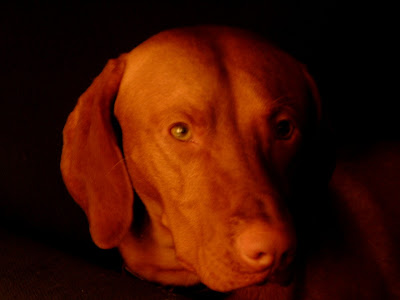
The sad, slightly shocking news after a nice Christmas break is that we had to put Elvis to sleep yesterday.

He'd been out of sorts for about a week -- the Wednesday before Christmas he ate a bunch of Christmas cookies from the kitchen counter while we were out, so for a few days we thought that was the cause. He went from his usual hyperactive happiness to lethargy, just laying on his favorite chair for the whole day. Given his history I started to suspect he'd eaten some object along with the cookies, even though he wasn't showing the typical "Oops, I guess I shouldn't have" GI symptoms. He wasn't throwing up, but he wouldn't eat anything.

The vet up in Lake Geneva (we spent last week there) examined him on Wednesday and did some quick blood work; everything looked OK, so she gave him a couple of GI meds and asked that we bring him back in a couple of days if he didn't rally.

Yesterday morning Elvis couldn't even stand, let alone walk, and looked to be in obvious pain. I decided to cut our vacation a day short and get him in to our regular vet (and good friend), Dr. Scott Jones at the Northbrook Animal Clinic.

Scott did x-rays looking for some obstruction, but instead found numerous tumors throughout Elvis's lungs. He indicated a) these were secondary tumors, with an unknown primary somewhere, b) there was no possible chemical treatment, and c) he didn't think Elvis would survive any possible surgery, given his condition. That left an easy decision, however sad and shocking. Scott took care of everything after that.

So Elvis gave us nine joyful, exasperating, heartwarming, hyperkinetic, goofy years, and we thank him for that. And I also thank Dr. Jones for rescuing him so many times in the past, and the Friends of Elvis who've been doing the weekday walks this last year and a half. I hope you enjoyed his energetic company as much as we did.

I won't offer up any obvious parallels or deep thoughts here. We'll miss him, but we'll be fine.

Pat

Wednesday, December 23, 2009

Merry Christmas!

There are still dozens of people in the United States not currently on my Christmas card list, so for you...


Merry Christmas!
(Yeah, it's like that around here.)
The Harrigans


(Note: picture will expand to full size when clicked.)

Pat


Monday, December 14, 2009

Waiting for Kenny

"You call this a snowstorm? Why, when I was a kid..."

We lived in Ashland, Ohio for a couple of years in the late '70's. Ashland is about halfway between Cleveland and Columbus (just off of I-71), so winter storms from the west sometimes steer under Lake Erie and hit hard. That certainly happened in January of 1978, when we got a blizzard they still talk about there.

On winter mornings we boys would get rousted out of bed early by my dad to shovel the driveway. This storm was different: we'd gotten close to 2 feet of snow - schlunk! - and the wind was blowing so hard that there was no way we could keep the driveway clear. After a while we gave up and went back inside, where my dad uncharacteristically accepted our excuse for not finishing a job. (I suppose, too, that it didn't seem useful to him to just drive to the end of the driveway, since the road was impassable.) School was canceled, of course.

One truck driver pulled over to the side of a road in nearby Mansfield during the storm, and his truck got drifted over. No one knew he was even there, so he was stuck in his cab for six days, but was eventually rescued -- cold and hungry, but otherwise OK:


There were cars stranded all up and down the interstate, and the state troopers had been corralling drivers to any rest area they could. The truck stop on the outskirts of Ashland -- the "Stop 250" -- had over 200 people in it. The local radio station was calling for people in town to take some of these stranded travelers into their homes for a day or two. We volunteered, since we were good citizens, and the truck stop manager was a neighbor of ours (Mr. Thurkettle. Really.)

Back then few people had 4-wheel drive, so the local "4x4" club was called into action. They ferried people from the truck stop to various homes around town in their Jeeps, and delivered groceries where needed. I'm sure they were thrilled to be put to work, their hobby suddenly becoming an important asset.

Our houseguests were a woman, her sister, and her young daughter. It turned out that they were traveling downstate to pick up the woman's husband, Kenny, who was being released from prison. My mom took that bit of news in stride, at least outwardly, but it was a secret thrill to us kids. Prison! Ooooh!

The visitors were as nice as could be, of course. We all spent a lot of time playing cards or board games; the only task for us boys was to keep a path shoveled to the end of the driveway, which we had to repeat (thanks to the wind) every couple of hours. I don't remember any of our guests' life stories, if they even shared them; they were pretty frazzled by the whole experience, and just looking forward to the reunion and the trip home.

After a day it worked out that Kenny had made arrangements to have a friend pick him up, and they were going to come to Ashland to get the family when the roads cleared. So we spent Day 3 holed up again, keeping the path shoveled to the street, waiting for Kenny.

By Day 4 the wind had died down, so we got to explore outside a little. The snowdrifts were freakishly large -- swooping sculptures at the corners of houses, from the ground to the roofline. With the other neighborhood kids we made the most awesome snow forts.

Kenny came that day. It was a pretty short visit; they wanted to move along back home, so our guests gathered their stuff and headed out. The only thing I remember about him was his tearful gratitude for taking care of his family.

At the time I didn't really identify with him, as he was a bit player in our four-day drama. (Prison! Ooooh!) But now I try to imagine what Kenny was feeling: stuck in prison after his release, probably watching the news on a crappy little prison black-and-white TV, seeing the storm's death toll mounting (it eventually hit 51). His wife and little girl were out on the road somewhere, and he was powerless to do anything. I'm guessing he said a prayer or two, or ten, and maybe made a bargain with The Big Guy during the ordeal.

His family wound up safe and sound, so I'd like to think he kept up his end of any bargain. Who knows? We shoveled the driveway, the roads got plowed, and after another day or two we got back to school.

Pat


Saturday, December 5, 2009

Duke Tumatoe is Not a Real Doctor

Casinos thrive on illusion -- some more than others. But a good bar band is an authentic thing.

I’ve been to Las Vegas a few times, and enjoyed it each time. My favorite thing is the artifice -- the fake gondolier taking you down a fake canal to the fake St. Mark’s Square in the Venetian. Or the fake steam (dry ice) coming from the fake street grates in the fake Greenwich Village in the New York, New York resort/casino. You get a slice of pizza, chuckle and say, “How about that!”

I’m not much of a gambler, as I just can’t get past the fact that every game is designed to take your money away. But when in Vegas I play blackjack; if you play “basic strategy”, hitting, splitting, and doubling down when you’re supposed to, it has the least bad odds of any game -- a house "edge" of about 0.5%. You can usually sit at the table for a good long time before those relentless statistics catch up to you. And if you’re sitting with friends, laughing and having fun, it’s money well spent.

I’ve read a couple of blackjack books, and you can actually turn the odds in blackjack slightly in your favor through card counting. It doesn’t require prodigious memory (like Dustin Hoffman in Rain Man), just concentration, but that makes it like a second job. No thanks.

The first time I saw Dr. Duke Tumatoe’s band was about 20 years ago, when they played at Biddy Mulligan’s in Rogers Park, just a block south of the Evanston/Chicago border. (It’s been shuttered for at least 10 years now, sadly.) My old roommate Mike was a big fan of live music, and they’d played his college town (Dayton) regularly, so he knew what fun they were. Off we went.

They were a very good bar band -- lots of upbeat songs and audience participation, and decent musicianship, as far as I could tell. Duke himself was an old man, bald, with a pot belly and a bushy white beard. He looked like Santa Claus, if Santa played a mean electric guitar, sang old and new rockin’ blues songs, and was a dirty old man. (The album he released in 2001 was titled "It's Christmas (Let's Have Sex)", which I don't think Bing Crosby ever recorded.)

The highlight of the show was when Duke switched over to his wireless electric guitar and strolled through the audience during one song. He then strolled right out the front door and into the middle of Sheridan Road, where he stood and whaled away for a minute or two, with cars passing by on either side, and everyone inside pressed against the windows watching and cheering. Crazy!

We did Thanksgiving in Michigan again this year, and had our usual wonderful time. There's a casino/resort 20 minutes away in Manistee (the Little River Casino), which I'd never cared to visit before. But I found out beforehand that the band playing at the bar that weekend was -- you guessed it -- Dr. Duke Tumatoe and his Power Trio. So we all went on Friday night, leaving the kids behind with Grandma.

When we got there we had a half-hour before the show started, so we split up to explore and gamble a little, according to our own preferences. I went looking for the blackjack tables, naturally. They were surprisingly crowded, and I didn't see any table I felt like joining alone, so I just watched.

The rules of casino advertising dictate that everyone is young, thin, beautiful, happy, and having a ball. I'm not a snob, but my observation of the Little River Casino: eh, not so much. A more typical customer is older, plain, heavy-set, and morose, smoking and joylessly pumping coins into a slot machine. (OK, maybe I am a snob.)

Duke's show started at 9pm, and was as fun as I expected. The solid blues songs, the comedy, the audience call-and-response -- it got more crowded as the night went on, as he seemed to pull people in from the casino floor. Duke himself didn't look any older, which is one virtue, I suppose, of looking like Santa Claus when you're in your forties. By his second set he had a fair number of people on the dance floor, off and on. (At one point, though, the lone dancer was a scraggly biker dude flapping wildly by himself in the middle of the dance floor, a cigarette in one hand and a beer bottle in the other. Go figure.)

We chatted a little with the keyboard player between sets. The band is based out of Indianapolis and plays over 200 gigs a year, almost all driving distance. They tour from Wednesday through Sunday, spend a couple of days at home, and then head back out -- almost all year round. It's a living, I suppose, and they seem to have fun doing it. They'll actually be back in Chicago on December 26th, playing at Kingston Mines in Lincoln Park.

So go see Duke Tumatoe and Co. if you get the chance, if live music's your thing -- I don't think you'll be disappointed. And remember to always split your aces and eights, and double down on 11, unless the dealer's showing an ace.

Pat

Sunday, November 22, 2009

Coopers and Fletchers

The second largest law firm in the world is Baker & McKenzie. I'm sure Mr. Baker was quite proud of his accomplishment, especially given that the ancestor whose name he carried was a baker -- you know, a guy who baked things. Way back when a "dusty baker" was probably covered in flour.

The surnames I've always gotten a kick out of are the ones related to a trade or profession. Many end in "er", of course, meaning "the guys who does..." Some end in "ward", as in "the guy responsible for". A "wright" made things, while a "smith" made or refined stuff, especially metal.

Some obvious ones:
  • Food and drink: Baker, Brewer, Butcher, Cook, Miller
  • Clothing: Tailor (Taylor), Weaver/Webster, Shoemaker, Glover
  • Housing and building: Thatcher, Carpenter, Sawyer ("the guy who saws"), Plumber, Bricker/Brickman, Mason, Waller
  • Farm and Field: Farmer, Hayward, Gardener, Shepherd, Shearer, Parker (in charge of a game park), Woodward
  • Transportation: Wagoner, Carter, and Porter all moved stuff around. They were dependent on the Wheelwright/Wheeler, Wagonwright (now Wainwright) and the Cartwright, any of these sometimes shortened to just Wright.
  • Making music: Piper, Harper, Singer
  • Gentry and clergy: Lord, Knight, Duke, Abbot, Bishop
  • Craftsmen and tradesmen: Turner (lathe operator), Smith (often short for blacksmith), Goldsmith, Coppersmith, Potter, Tanner, Barber, Stringer, Roper
  • Boating and seafaring: Keeler (bargeman), Fisher, Boatman, Waterman
The less obvious ones are the best:
  • A Cooper was a barrel-maker, and a Hooper made the hoops for the barrels. They were buddies, I'm sure.
  • Mr. Fletcher made arrows. His best customers were probably Mr. Archer, Mr. Bowman, and the guy who made the bows, Mr. Bowyer (now Boyer.)
  • A Faulkner was in charge of falcons.
  • Tucker, Fuller, and Walker were all names of people who cleaned and thickened cloth.
  • Barker worked in tanning. Using tree bark in the process, I guess?
  • A Dexter dyed cloth.
  • Peterman was another name for Fisher.
Interesting, too, that there are feminine versions -- in English these end in "ster" or similar. So Brewster for Brewer, Baxter for Baker, etc. And another name for judge was Deemer, whose feminine form was Dempster.

It was the same in other European countries, of course, so Smith is Schmidt in German and Lefevre in French, while Miller is Molina in Spain and Molnar in Hungary.

Fun, huh? I think very few people who carry a profession or trade surname would want to go back to that line of work, in this day and age. Unless you wanted to make and sell knives instead of playing football. Eh, Mr. Cutler?

Pat